FAQ
Who needs to be in a car seat?
Any person who is not at least 4 feet 9 inches tall needs to be in some sort of car seat or booster seat. This usually does not happen until the ages of 8 – 12 years old. This is largely due to the fact that a child’s body cannot handle the impact of an accident, and that seatbelts were actually designed for adults. A child that is smaller than 4 feet 9 inches tall has the protentional of being strangled or even decapitated from a regular seat belt when used alone. This blog will go more in depth about why those requirements are so important and we will review the myths around switching out of car seats too early.

What type of car seats are there?
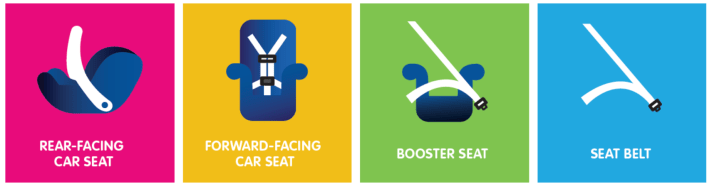
There are 3 main types of car seats – infant carriers, convertible seats, and booster seats.
Infant carriers are rear facing car seats only. Convertible car seats can be used as rear facing or forward facing when the child has completely grown out of the rear facing limits. Boosters seats are for children 5 years and older who are mature enough and big enough to sit properly with a seat belt.
For more information about the different car seats check out another post about the 4 Stages of Car Seat Safety here. https://safetyseats.car.blog/2019/06/10/the-4-stages-of-car-seat-safety/
I am not a bad driver! Why are car seats such a big deal?
“It won’t happen to me.” Is the worst thing to think when it comes to car seats. It’s not about YOU, it’s about those around you. The person who drank too much and got behind the wheel. The teenager who didn’t see you when merging lanes. The truck driver who is a little too sleepy. The deer or dog or child who bolted in front of the road and made you go swerving into a light pole. Are any of these your fault? Are any of these things an indication of your driving skills? No! Car seats are important for the same reason seat belts are important. They are your insurance in the car to keep you and your kids safe.
It’s not even about the car seats themselves, it’s about how you use them. Only 5% of car seats are being using correctly. This means 95% of children are at an extremely higher risk in the car. If the car seat is not installed properly in the car, or if your child is not properly placed in the car seat, a simple thing like hitting a deer or rear ending someone could mean a lot more when the car seat or child is ejected from the car on impact.
I know, I know. That was a bit dramatic. But did you feel that? The emotions of thinking about your child crashing through the window because their buckle was too loose or because the car seat was installed incorrectly? I hope you felt it, because it is a big deal! Some of the most seemingly “simple” accidents can be fatal for a child who is not restrained correctly in their car seat. You may not be able to control the drivers around you, but injuries related to improper installation and use are 100% preventable.
Why do I need to rear face my child that long?
This answer could be an entire own blog on its own. A child’s body is still growing and they have more bones and flexibility than adults do. Their bodies are not built to handle to impact of accidents. There are numerous injuries that can occur when a small child is forward facing before they are big enough. Such as – whip lash, internal decapitation (yes, that’s a thing), broken necks, spinal injuries, and nerve injuries to name a few. You should always wait until your child has reached the maximum height or weight limit of the rear facing car seat before forward facing them. It has been PROVEN to be the safest option for every child. This is when their bodies are strong enough to handle a forward facing impact in the event of an accident.
I promise their long legs will be okay. A broken leg is better than a broken neck.
I promise they will okay without seeing you the entire time while driving. A few upset moments in the car is better than a life long spinal injury.
And I promise they won’t know the difference between rear and forward facing until they are actually ready to make the switch. It is also never too late to go back! Kids are resilient and can handle almost anything we throw at them, including a switch of position in the car.

Why do I need to replace a car seat after a motor vehicle accident?
If an accident has enough impact to shatter/crack any windows or enough force to deploy the airbags then the car seats need to be replaced, even if the child was not in the car at the time of the accident. This is because an accident has the potential damage the inside of the car seats. All car seats have an expiration date and if you are using an older car seat the inside of it is more likely to be damaged in an accident. If the car seat is damaged the first time, it will not be as effective at protecting your child the next time.
When I was in the accident that totaled my car with my 1-year old son, his car seat looked completely fine. I had to actually send the car seat to my auto insurance for reimbursement. After they got the car seat they cut it open and found the entire inside of the protective material had shattered. There was no way I could have known this by looking at it from the outside.
Always contact your auto insurance after an accident to get information about your options for car seat reimbursement.
How do I know which car seat to get?
Looking at car seats can be overwhelming. There are so many options. Do you get the cheap $80 one or the $300 one? The one that can used for 8 years or only the infant carrier? The one that connects to the stroller? The one with the easy connect latch system? AHHHHH!
Don’t fret! The fact is ALL car seats in the United States have to pass the same safety standards before even being put on the market. The extra price, bells and whistles, and added conveniences are all optional and not required to keep a child safe in the car.
Find a car seat that works for you family and one that fits in your car and budget. That’s all you need!
How do I know if I am using my car seat correctly?
Read this blog! I will provide everything you need to make sure you are confident in your car seat installation and use. You can also contact your local hospital, police station or fire department to find resources in your area for car seat assistance.
 Car Seat Master
See what others are saying: