Hello and welcome to the first step in becoming your own Car Seat Master! Today we are going to discuss the 4 different stages to car seat safety. Each one has its own purpose and are all equally important for the safety of your child in the car.
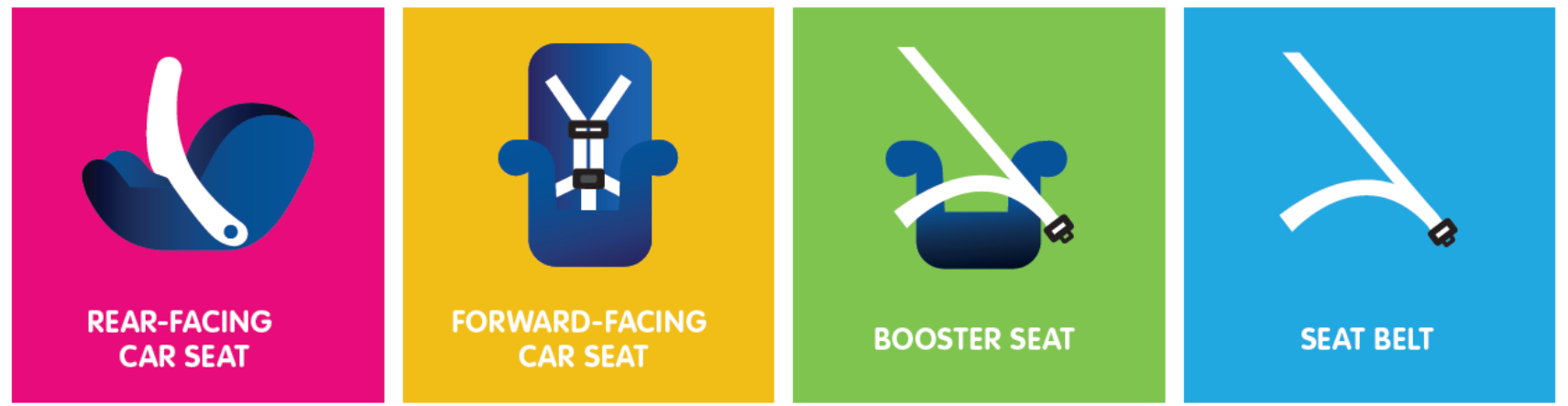
1. Rear Facing
The first stage of car seat safety is a rear facing car seat. There are two types of rear facing car seats; infant carriers and convertible car seats. Rear facing car seats are vitally important in the first 2 years of a child’s life. The American Academy of Pediatrics recommends a child should be rear facing as long as possible. In fact, some states have passed laws requiring children to be properly restrained in a rear facing car seat until at least 2 years old.
Most families with new babies will have an infant carrier. An infant carrier is an easy and convenient way to move a younger baby in and out of the car. Most infant carriers will have a weight limit of 20 pounds, at which point the child should be transferred to a rear facing convertible car seat. Convertible car seats have a much higher rear facing weight limit, which is usually around 40 lbs.
Why is rear facing so important? The American Academy of Pediatrics says –
“When a child rides rear-facing, the head, neck, and spine are all supported by the hard shell of the car safety seat, allowing the car seat to absorb most of the crash forces, and protecting the most vulnerable parts of the body. When children ride forward-facing, their bodies are restrained by the harness straps, but their heads – which for toddlers are disproportionately large and heavy – are thrown forward, possibly resulting in spine and head injuries.”
2. Forward Facing
Rear facing protects your child from serious head, neck, and spinal injuries (such as whiplash, broken vertebrae, and internal decapitation). In another post we will go more in depth about the importance of rear facing car seats and debunk the most common car seats myths.
The second stage in car seat safety is forward facing. Most forward facing car seats will be a convertible car seat, which can also be used as forward facing and sometimes as a booster seat. It is best to wait to switch a child into a forward facing car seat until they are at least 2 years old, but not recommended until have reached the maximum weight or height requirements for the rear facing position. This could sometimes be 4 years old or later depending on size of the child. Always follow the manufacturer’s instructions and weight/height limits for each specific car seat.
It is very common to place a child in the forward facing position too early. This puts the child at risk for serious injuries or death. Follow along and we will discuss later why waiting to forward face is so important.
3. Booster Seat
The booster seat is an important step and is often skipped all together. It is the last step before a child can use a seatbelt only. Booster seats are a seat cushion used to elevate the child in the car and uses the regular seat belt across their body. Booster seats start with a back attached and then move onto a backless booster seat.
A child should be in some type of car seat or booster until they are at least 4’9” tall and 8 – 12 years old. Aside from the size and height of the child, they must also be mature enough to handle sitting in a booster properly and be able to understand seat belt safety.
4. Seat Belt
We made it! The seat belt is the last stage of car seat safety. There is no need to rush to this stage. The height and weight requirements for car seat safety are designed to protect your child. The smaller a child is the more protection they need. Only when they are old enough, mature enough, and big enough will they be safe in the car with the seat belt only.
Make A Difference With Me
Motor vehicle crashes were the #1 cause of death among children and adolescents in 2016 and only 5% of car seats are being installed and used correctly. Help me change this by following this blog, sharing it with your friends, and becoming your own Car Seat Master! And then ask yourself – Is your child in the right seat?
Sources:
 Car Seat Master